

SpaceX Goes Public at $1.77 Trillion: The Biggest IPO in History or the Start of a Market Frenzy?
SpaceX has officially gone public at a staggering $1.77 trillion valuation.
The IPO instantly became the largest public offering in history and pushed Elon Musk closer than ever to becoming the world’s first trillionaire. The event has dominated financial headlines, sparked debates across Wall Street, and created a new question for investors everywhere:
Is SpaceX the opportunity of a generation—or the beginning of a dangerous speculative frenzy?
The answer is more complicated than most investors realize.
The SpaceX IPO Is A Trap
The Biggest IPO the World Has Ever Seen
A $1.77 trillion valuation immediately places SpaceX among the largest companies on Earth.
This is no ordinary IPO.
SpaceX is not just a rocket company.
It combines several potentially transformational businesses:
- Space launch services
- Starlink satellite internet
- National defense infrastructure
- Global communications
- Artificial intelligence through xAI
- Potential future integration with Tesla technologies
For many investors, SpaceX represents a direct investment in humanity’s future.
But history shows that even the greatest companies can become poor investments when purchased at the wrong price.
The Low Float Dynamic
One of the most important aspects of the IPO is something many retail investors overlook:
Only about 4.25% of shares are currently available for trading.
This creates what crypto investors would immediately recognize as a low-float, high-valuation launch.
Crypto traders have seen this pattern countless times:
- Small circulating supply
- Massive fully diluted valuation
- Explosive initial demand
- Violent price discovery
- Eventual unlock-driven selling pressure
The mechanics are similar regardless of whether the asset is a stock or a token.
When demand greatly exceeds available supply, prices can move dramatically higher.
The danger comes later.
Why SpaceX Could Continue Rising
Many investors are surprised to hear that some analysts remain bullish despite concerns about valuation.
The reason is simple.
There are very few shares available.
When institutions, funds, and retail investors all attempt to gain exposure simultaneously, the lack of available stock can create a supply squeeze.
This is one reason why many traders believe shorting SpaceX immediately after the IPO could be dangerous.
The market has repeatedly demonstrated that low-float assets can remain irrationally strong for extended periods.
The shortage of supply can overwhelm traditional valuation models.
At least temporarily.
The Unlock Risk Nobody Is Talking About
The real story may not be today’s trading.
The real story begins later.
SpaceX has a significant unlock schedule scheduled after earnings reports and throughout the following months.
As additional shares become available:
- Early investors can take profits
- Employees can liquidate positions
- Supply increases dramatically
This changes the market dynamic.
Instead of too few shares chasing massive demand, the market begins absorbing increasing amounts of stock.
This is often when true price discovery begins.
Crypto investors know this phenomenon well.
Many tokens surge during the low-float phase and then face pressure as vesting schedules release additional supply.
SpaceX may experience a similar pattern.
Valuation: Is SpaceX Actually Cheap?
The simple answer is no.
At current prices, SpaceX trades at valuation multiples that imply extraordinary future growth.
Investors are not paying for today’s business.
They are paying for:
- Future space commercialization
- Future satellite dominance
- Future AI integration
- Future transportation networks
- Future technological breakthroughs
To justify current valuations, SpaceX may need decades of exceptional execution and potentially 30–60% annual growth rates over extended periods.
That sounds aggressive.
But then again, Elon Musk has built multiple companies that many experts once considered impossible.
Will SpaceX Hurt Crypto?
One of the biggest fears circulating online is that investors will sell Bitcoin, Ethereum, and other digital assets to buy SpaceX.
This concern may be overstated.
Large institutional Bitcoin holders are unlikely to suddenly abandon their positions to chase an IPO.
Bitcoin’s largest buyers are:
- ETFs
- Institutions
- Corporate treasuries
- Long-term holders
These participants typically operate on much longer time horizons.
Retail investors may shift some capital.
But retail alone rarely drives Bitcoin’s macro trend anymore.
The crypto market today is increasingly institutionally driven.
The Real Liquidity Risk
If SpaceX affects markets, the impact may be greater in equities than in crypto.
Investors looking to fund SpaceX purchases could rotate out of other technology stocks.
Potential sources of capital include:
- Semiconductor stocks
- Growth stocks
- Software companies
- Innovation funds
This could create localized weakness across parts of the Nasdaq even if the overall index remains relatively healthy.
In other words:
SpaceX may not hurt Bitcoin.
But it could compete with other growth stocks for investor attention and capital.
Is SpaceX Signaling a Market Top?
This is perhaps the most interesting question.
Historically, major IPOs often appear near periods of peak optimism.
Examples include:
- Dot-com era IPOs
- Social media IPOs
- Technology booms
- Speculative market peaks
Some investors argue that the SpaceX IPO represents another warning sign.
However, reality is rarely that simple.
Markets are influenced by:
- Interest rates
- Inflation
- Economic growth
- Corporate earnings
- Global liquidity
- Geopolitics
One IPO alone rarely causes a major market reversal.
Could SpaceX contribute to market euphoria?
Absolutely.
Could it eventually be remembered as a late-cycle event?
Possibly.
But broader macroeconomic conditions will likely determine that outcome.
The OpenAI and Anthropic Wildcard
The story becomes even more interesting when considering what may come next.
Future public offerings could include:
- OpenAI
- Anthropic
- Other major AI companies
Imagine a market simultaneously absorbing:
- SpaceX
- OpenAI
- Anthropic
Each potentially worth hundreds of billions—or even trillions—of dollars.
This could create one of the largest liquidity events in financial history.
If combined with rising rates, slowing growth, or economic stress, it could become a significant challenge for equity markets.
Why Investors Should Stay Patient
One of the most valuable lessons from the SpaceX IPO is the importance of patience.
Many investors feel pressure to buy immediately.
Fear of missing out can be powerful.
But successful investing is rarely about speed.
It is about risk-reward.
The best opportunities often emerge after:
- Initial excitement fades
- Volatility subsides
- Supply increases
- Valuations normalize
For long-term investors, waiting for better entry points may prove more rewarding than chasing the first day of trading.
The Long-Term Bull Case Remains Massive
Despite valuation concerns, the long-term thesis for SpaceX remains compelling.
Few companies possess:
- Elite leadership
- Global infrastructure
- Massive addressable markets
- Technological advantages
- Government relationships
- Future optionality
SpaceX is attempting to reshape:
- Communications
- Transportation
- Defense
- Artificial intelligence
- Space exploration
That combination is extraordinarily rare.
The challenge is not determining whether SpaceX is a great company.
The challenge is determining whether today’s price properly reflects tomorrow’s potential.
Final Thoughts
The SpaceX IPO represents more than a stock market event.
It represents a new phase in the relationship between technology, innovation, artificial intelligence, and capital markets.
In the short term, low float dynamics may continue supporting the stock.
In the medium term, unlock schedules and valuation concerns may create volatility.
In the long term, SpaceX could become one of the defining companies of the century.
The biggest mistake investors can make is confusing a great company with a guaranteed investment.
SpaceX may ultimately justify its valuation.
Or it may spend years growing into it.
Either way, one thing is certain:
The SpaceX IPO has become one of the most important financial stories of 2026—and its impact on stocks, AI, and the broader investment landscape is only just beginning.
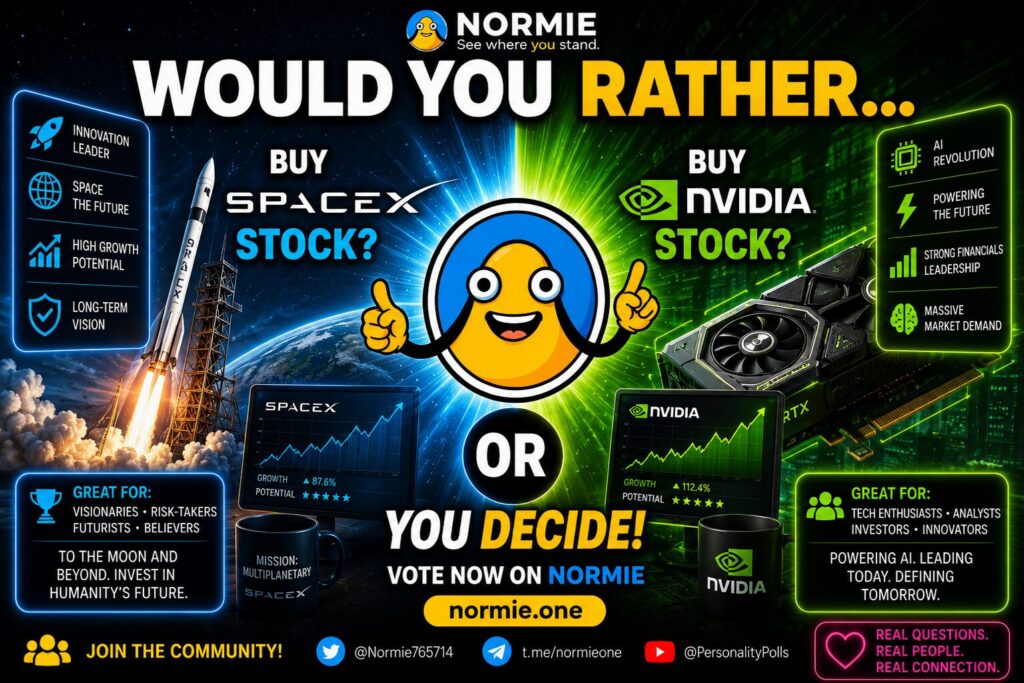
Would You Rather…
Own a piece of the future of space exploration with SpaceX 🌎🚀
OR
Own a piece of the AI revolution with Nvidia 🤖📈
One is building humanity’s path to the stars.
The other is powering the machines transforming our world.
Both could shape the next decade.
But you can only choose one.
🗳️ Vote now on Normie and see where you stand:
https://www.normie.one
#SpaceX #Nvidia #AI #Investing #Stocks #FutureTech #WouldYouRather #Normie #NORMIE #PersonalityPolls #Space #ArtificialIntelligence #Innovation #DEO