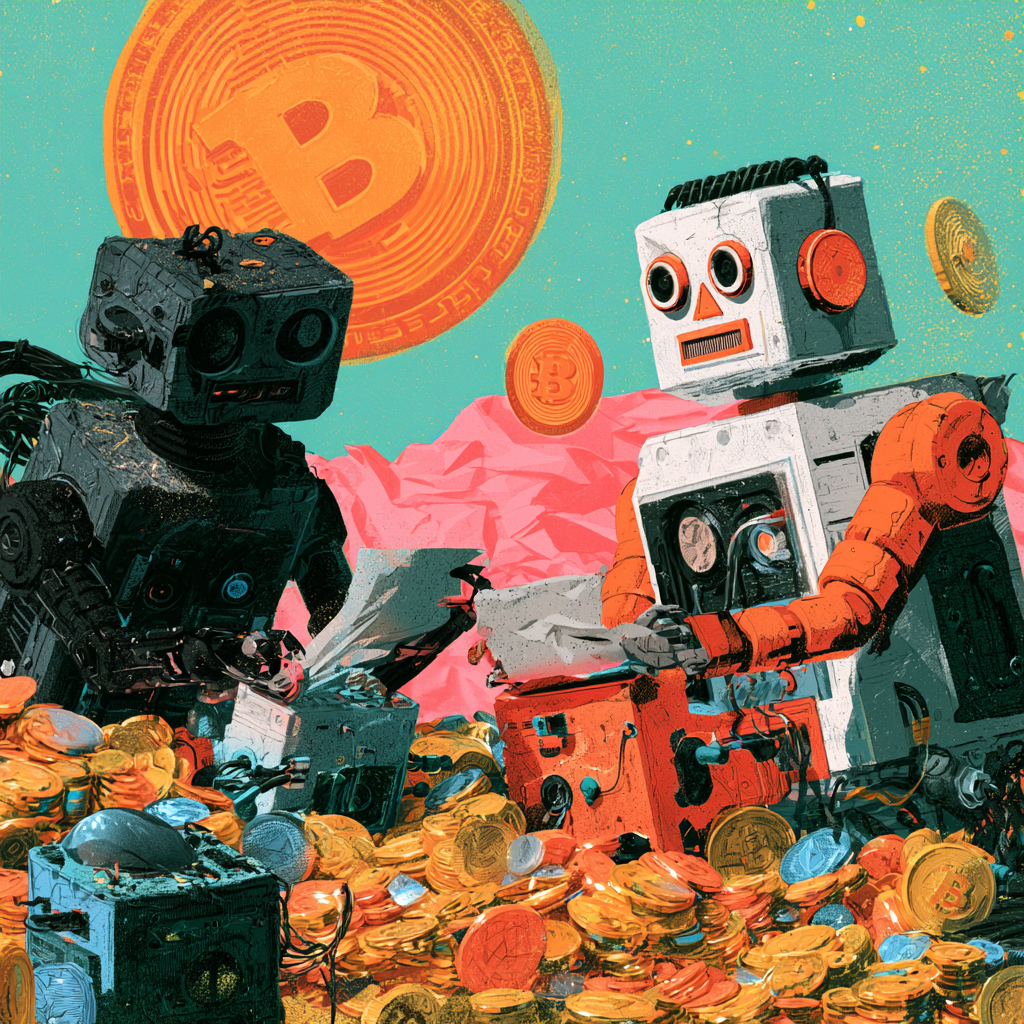
Crypto Has Spent 15 Years Chasing Humans. What If Machines Are the Real Mass-Adoption Event?
For most of crypto’s history, the industry has been obsessed with one question:
How do we get normal people to use blockchain?
We simplified wallets, lowered fees, built better apps, launched NFTs, DeFi, memecoins, games, ETFs, Layer 2s and countless “consumer-friendly” products.
And yet crypto still often feels awkward for ordinary people.
Seed phrases are confusing. Bridges are risky. Network choices are annoying. Transactions can be irreversible. One wrong click can be expensive.
Maybe that is because humans were never blockchain’s most natural users.
Machines might be.
AI Is Moving From Talking to Doing
The first phase of generative AI was mostly conversational.
Ask a question. Get an answer.
The next phase is different.
AI agents are beginning to search, compare, plan, book, buy, trade, monitor and coordinate work.
Once software begins acting in the world, it eventually needs money.
An AI travel agent may need to purchase a hotel room. A research agent may pay for specialized data. A business agent may buy compute, software or advertising. A trading agent may rebalance collateral around the clock.
At that point, AI stops being merely an information system.
It becomes an economic participant.
And economic participants need identity, permissions, money and settlement.
AI gives software intelligence. A wallet gives it economic agency.
Machines Actually Like the Things Humans Find Difficult
A person does not want to think about gas fees, APIs, wallet addresses or transaction routing.
Software does not care.
A machine can monitor five networks simultaneously, compare costs instantly, execute hundreds of micropayments, maintain accounting records and follow spending rules without becoming tired or distracted.
That changes the way we should think about crypto adoption.
We have spent years trying to hide blockchain complexity from humans.
AI agents may simply absorb that complexity themselves.
The human says:
“Find me the best flight under $500.”
The agent searches, negotiates, books, pays and records the transaction.
The person experiences convenience.
The machine experiences blockchain.
That may ultimately be a much stronger adoption model than teaching billions of people how to bridge USDC.
Stablecoins Could Become Machine Money
This is where stablecoins become especially interesting.
Bitcoin may be excellent long-term money, but an AI agent buying $0.07 worth of data probably does not want its operating budget fluctuating wildly.
Machines need predictable purchasing power.
Stablecoins offer something remarkably compatible with autonomous commerce: global availability, programmable payments, 24/7 settlement and the ability to make extremely small transactions.
Imagine an AI agent paying:
$0.01 for a database query.
$0.04 for inference.
$0.15 for storage.
$1.20 for a specialized research task.
Humans rarely make hundreds of tiny transactions each day.
Machines may make millions.
Crypto spent years dreaming about micropayments. AI may finally give micropayments a customer.
The Machine Economy Gets Bigger Quickly
Now move beyond AI assistants.
An electric vehicle could automatically pay a charger.
A delivery robot could pay a toll.
A factory could purchase electricity dynamically.
An AI model could rent GPU capacity for thirty seconds.
One agent could hire another agent to complete a task and immediately settle payment.
The economic relationship changes from:
Human → Business
to increasingly:
Agent → Business
Agent → Agent
Machine → Machine
And the machine economy never closes.
It does not wait until Monday morning.
It does not care about banking hours.
It operates at software speed.
That makes always-on financial infrastructure much more important.
Blockchain Is Surprisingly Well Suited to This
Traditional finance was designed around people, companies and institutions.
Blockchain was designed around programmable ownership and programmable value.
That distinction could become incredibly important.
An AI agent does not necessarily need a traditional bank account if it can operate through a wallet with carefully defined permissions.
For example:
Spend no more than $200 today.
Only pay approved providers.
Never transfer long-term holdings.
Use only stablecoins.
Require human approval above $1,000.
Those rules can increasingly be embedded in wallets and smart contracts.
The goal should not be giving machines unlimited control.
It should be giving machines limited authority inside human-defined boundaries.
The future of AI finance is not “trust the robot.” It is “trust the rules around the robot.”
Reputation May Matter as Much as Money
Agents will also need to know whom they can trust.
If one AI wants to hire another AI to perform research, coding or financial analysis, it needs some way to evaluate its history.
Was the agent accurate?
Has it completed similar tasks?
Has it been flagged for fraud?
Does it have verifiable credentials?
Blockchain could provide part of that reputation layer.
The same infrastructure used to record transactions could eventually help establish histories for machine performance, identity and reliability.
Money allows machines to transact.
Reputation allows them to cooperate.
This Could Be Crypto’s Real Mass-Adoption Moment
Crypto has always talked about reaching the “next billion users.”
But there is no reason the next billion wallets must belong to people.
One person could eventually operate dozens of specialized agents.
Companies could operate thousands.
Platforms could operate millions.
And agents themselves could create temporary sub-agents whenever a task requires specialized expertise.
The number of economic software entities could eventually become far larger than the number of humans using crypto directly.
That is the contrarian idea:
Crypto adoption may explode without most people consciously becoming crypto users.
The blockchain becomes infrastructure.
The AI handles it.
The human simply benefits from the result.
But This Is Not Guaranteed
There is plenty of hype here.
Most AI agents today are still relatively limited. Compliance, fraud, security, identity and legal responsibility remain major unresolved problems.
Traditional financial companies are also developing agent-friendly payment infrastructure, so blockchain will not automatically win every machine transaction.
The likely future is hybrid.
Banks, card networks, stablecoins and public blockchains will probably coexist.
The winners will be whichever systems make machine commerce safest, cheapest and easiest.
That is why the opportunity is bigger than simply buying tokens labeled “AI.”
The real infrastructure may involve stablecoins, wallets, smart-contract networks, decentralized compute, identity systems, exchanges and tokenized assets.
The Bigger Shift
Crypto’s first era was largely about humans trading digital assets.
Its next era could be about software using digital infrastructure.
That would change the character of the industry.
Less speculation for speculation’s sake.
More invisible settlement.
More automated commerce.
More machine-to-machine payments.
More transactions nobody posts about on X because nothing dramatic happened.
And that may actually be the most bullish outcome.
Crypto finally becomes boring enough to become indispensable.
Final Thought
Bitcoin gave the internet native money.
Ethereum gave it programmable value.
Stablecoins gave it programmable dollars.
AI agents may give the digital economy something new:
native economic actors.
Crypto spent 15 years trying to convince humans to become better blockchain users.
The surprising possibility is that machines may already be better suited to the job.
The next billion crypto users may not have names or smartphones. They may have wallets, APIs and objectives—and transact more in a day than most humans do in a year.