Memecoins Aren’t Dead. They’re Splitting Into Two Very Different Worlds.
At TOKEN2049, a debate about attention, community, and AI revealed the bigger question facing crypto: what gives people a reason to stay?
A new token appears. A familiar face promotes it. The chart moves. Traders rush in, hoping they have arrived before everyone else.
Then attention shifts.
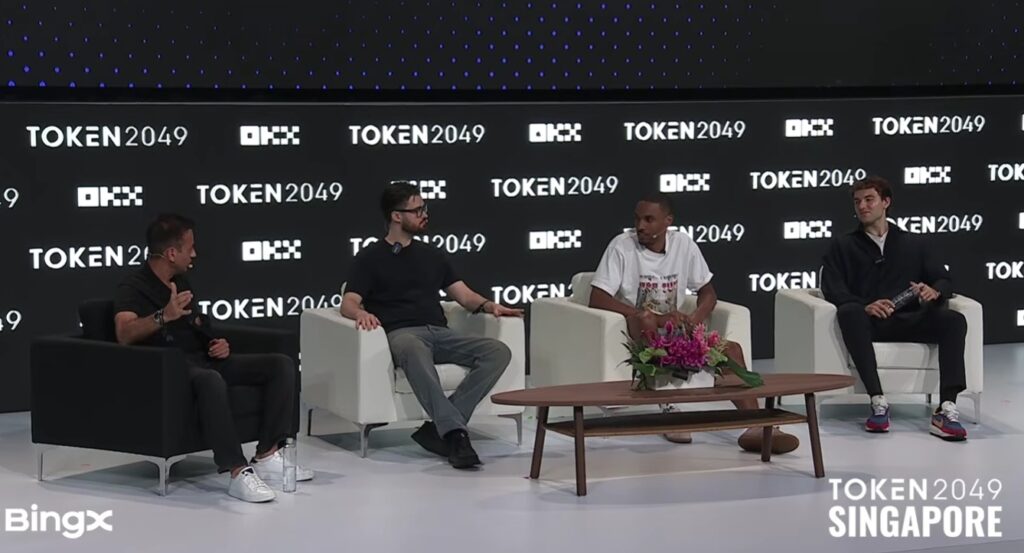
That familiar cycle sits at the center of “Memecoins: Dead or Just Getting Started?”, a TOKEN2049 Singapore 2026 panel moderated by Crypto Banter founder Ran Neuner, featuring investor Murad Mahmudov, Bullpen co-founder Ansem, and fomo CEO Paul Erlanger.
Their discussion suggests that the question in the title may be too broad.
Memecoins could be developing along two different paths: an increasingly crowded market for rapid speculation, and a smaller group of communities attempting to build lasting identities around tokens.
Both depend on attention. What they do with that attention could determine their future.
Memecoins: Dead or Just Getting Started? – TOKEN2049 Singapore 2026
When Launching Is Easy, Standing Out Gets Harder
Ansem’s starting point is straightforward: memecoins are driven by attention and collective belief.
His argument is that the proliferation of launches fragments that attention. More tokens compete for the same screens, conversations, and speculative capital.
A recognizable character or timely joke might attract an initial audience. Sustaining interest requires differentiation.
That creates a difficult environment for projects built mainly around novelty. Their appeal can disappear as soon as something newer arrives.
For builders, the challenge becomes maintaining a reason for people to return. For market participants, it becomes distinguishing a temporary burst of visibility from something with staying power.
Those are different tasks from simply spotting a rising chart.
Murad’s Bet: Some Memecoins Become Movements
Mahmudov argues that the market is dividing between rapid gambling and deeply committed communities.
At the speculative end, he expects more launches, shorter holding periods, and increasingly fragmented demand. At the other end, he sees the possibility of enormous tokenized movements built around shared beliefs.
His prediction of an eventual trillion-dollar memecoin is a forecast, rather than an outcome established by the discussion.
The more interesting part is his explanation of why such communities might form.
He believes economic frustration could encourage people to organize around assets that symbolize a shared response. A token would become a way to express identity, demonstrate commitment, and participate in a collective ambition.
That interpretation expands the conversation beyond internet jokes. It treats some memecoins as experiments in organizing people around a financial symbol.
Whether those experiments improve participants’ lives remains an open question.
What Does Owning the Token Actually Mean?
Neuner repeatedly brings the conversation back to a useful question: what is the buyer getting?
Joining a community can offer entertainment, relationships, recognition, and a sense of purpose. Buying its token introduces a separate set of questions.
Does ownership provide access, governance rights, rewards, or any claim on economic activity? How does community growth connect to token demand? Who controls the supply?
The panel’s emphasis on tokenizing brands, culture, and ideology makes those distinctions especially important.
A token can be associated with a movement without representing ownership of its intellectual property, revenue, or organization.
The cultural appeal of a community and the economic characteristics of its token need separate explanations.
Social Trading Changes the Incentives
Erlanger describes fomo’s effort to encourage longer holding periods through social features, visible holdings, and incentives.
The broader idea is that communities and financial activity could occupy the same platform. Instead of discussing assets in one place and trading them somewhere else, people could discover ideas, follow participants, and observe holdings within a shared experience.
That could add context to financial commentary.
A person’s visible actions may reveal something their promotional posts leave out. But visibility has limits. A displayed wallet does not necessarily reveal someone’s full financial position, outside arrangements, or other accounts.
Social accountability also introduces pressure.
When followers interpret a prominent holder’s sale as a loss of faith, an ordinary portfolio decision can become a public event. Longer holding periods may reflect conviction, social expectations, or both.
Conviction Has a Cost
One of the panel’s most striking moments comes when Mahmudov says his tracked wallets fell in value from approximately $90 million to $9 million. He presents this self-reported decline as consistent with his much longer investment horizon.
The exchange illustrates how different “long-term conviction” can feel when expressed in dollars.
A committed holder may accept extreme volatility. That willingness does not establish that recovery will follow.
Nor does continued community activity during a downturn prove that a token is attractively valued.
Posting, creating, and organizing can demonstrate resilience. They can also coexist with deteriorating liquidity or an unsuccessful investment thesis.
A healthy community needs room to discuss both possibilities.
AI Could Reshape the Competition
The discussion takes a broader turn when the panel considers AI.
Mahmudov predicts that increasingly capable agents will compete aggressively in trading and token launches, weakening human advantages over short time horizons.
Ansem sees a possible premium on recognizable people and established relationships when synthetic content becomes more abundant.
Erlanger emphasizes AI’s role in discovery and research, including helping users understand tokens and navigate ideas.
These are scenarios, rather than settled outcomes. Together, however, they expose an important tension: if producing content and launching tokens becomes easier, attracting attention may become even more competitive.
Trust could become more valuable—and more difficult to establish.
A Community Needs Something to Do Together
The strongest version of the movement thesis gives members meaningful activities beyond promoting the token.
People might create media, organize events, develop tools, teach newcomers, or collaborate on projects. Those contributions can improve the experience even during an uneventful market.
That is also a practical way to assess a project’s ambitions.
What can someone contribute? How are contributions recognized? What funds any promised rewards? Can members disagree without losing their place in the group?
The answers reveal more than the intensity of a slogan.
The Question Behind the Debate
The panel offers a compelling explanation of how attention can become identity and how identity might sustain a token community.
It does not establish that the most committed communities will necessarily produce the best investment outcomes.
The distinction matters.
A movement can be culturally influential while its token remains difficult to value. A community can feel welcoming while its ownership is concentrated. A long holding period can reflect patience without producing a return.
The next chapter of memecoins may therefore depend on something more demanding than visibility or belief alone: whether projects can turn shared attention into experiences and accomplishments that people continue to value.
When the market goes quiet, what brings the community back tomorrow?
That question deserves as much attention as the next price target.

Beyond the Chart: Why Normie Fits Crypto’s Community Movement
My reaction to TOKEN2049’s memecoin debate—and where participation platforms like Normie could take the conversation next.
The question that stayed with me from TOKEN2049’s “Memecoins: Dead or Just Getting Started?” was simple: when someone buys into a tokenized community, what are they actually joining?
Murad Mahmudov describes a future in which shared identity and collective belief help some memecoins become movements. Ansem emphasizes attention and relationships. Paul Erlanger discusses bringing community and financial activity into the same social experience.
Together, their arguments point toward an opportunity: give people something meaningful to participate in.
That is where Normie fits.
A Question Gives People a Reason to Join
Normie starts with something almost anyone understands: a “Would You Rather” question.
Answer a question, compare your response with others, and explore why people think differently. Its personality polls, shareable questions, videos, and deeper discussions provide an accessible entry point into a community.
You can participate because a question makes you laugh, challenges your assumptions, or starts a conversation with a friend.
That matters. A tokenized movement needs reasons for people to show up beyond checking its price.
Normie’s opportunity is to turn curiosity into conversation—and conversation into lasting participation.
From PvP Trading to PvE Community Building
Crypto often describes rapid speculation as PvP: player versus player. Participants compete to enter earlier, react faster, and find an exit.
A community moves toward PvE: player versus environment when members work together on shared challenges.
For Normie, that could mean creating better questions, producing entertaining videos, welcoming newcomers, or helping people understand different perspectives.
Imagine a member submitting a thought-provoking poll. Another creates artwork around it. Someone else turns the discussion into a short video.
Those contributions improve the experience for everyone. They also give members roles beyond being buyers or promoters.
A token does not automatically create that culture. The community has to practice it.
The Human Connection in an AI World
The panel’s AI discussion makes this especially relevant. If automated systems produce more content and compete more aggressively in markets, recognizable relationships could become more important.
Normie can explore that territory through everyday human choices: ambition or balance, adventure or security, being understood or being admired.
AI can help organize discussions and suggest questions. Members supply the experiences and reasoning that make those discussions interesting.
The challenge is to encourage thoughtful participation rather than reward sheer activity. A hundred automated answers should not count for more than one original contribution that sparks a worthwhile conversation.
Give the Token a Purpose People Can Explain
Normie’s website links to its crypto token. The next question is how that token supports the experience.
Potential directions could include rewards for verified contributions, access to selected community experiences, or participation in funding decisions. These are possibilities to develop, rather than claims about benefits currently available.
Whatever the design, members should understand what ownership provides and how any rewards are funded.
Community growth alone does not guarantee token returns. Keeping that distinction clear helps build trust.
A Movement Needs Something to Do Together
My reaction to the panel is that belief becomes more convincing when it leads to useful action.
For Normie, that action can begin with something small: answer honestly, consider another perspective, create something original, or invite a friend into an interesting discussion.
Its “Where Average is Awesome!” message gives that participation a welcoming identity. Ordinary people have experiences worth sharing and ideas worth hearing.
The test remains simple: if the token price stayed flat for a year, would people still want to participate?
Normie has the beginnings of an answer in its polls, humor, and shared curiosity. Building on those experiences could give its community story substance.
Come for the question. Stay for the people. Help shape what comes next.