Where Does the Interest Actually Come From?
A stablecoin promising 8% sounds like a savings account with better marketing. It isn’t. It also isn’t automatically a scam. Somewhere between those two reactions is the only question that matters: where does the interest actually come from?
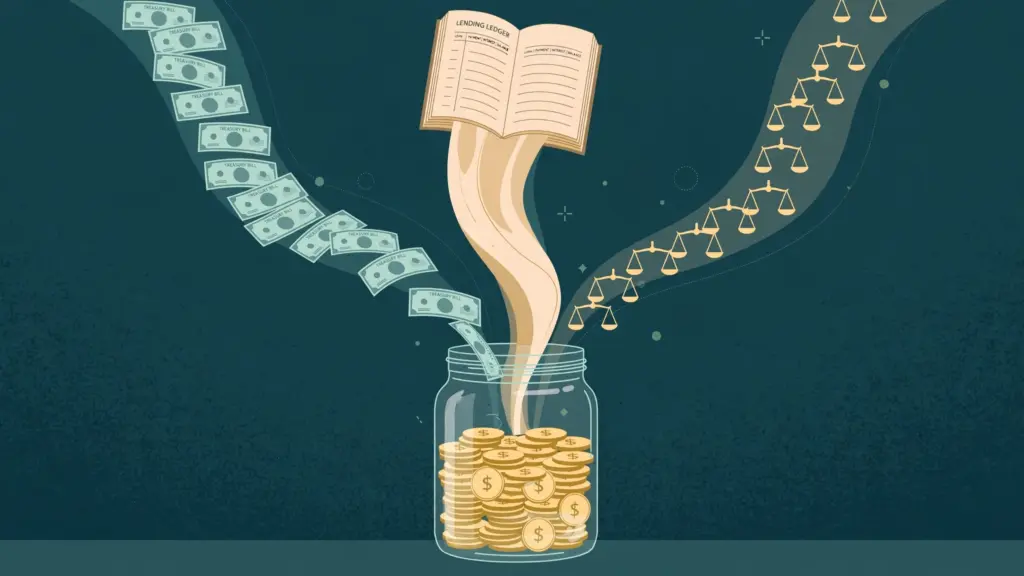
Every legitimate yield has a source — someone, somewhere, is paying for the use of your dollars. If you can name that payer and understand what they’re doing with the money, you can judge the risk. If nobody can name the payer, you are probably the payer. This article traces the three main sources of stablecoin yield, what can go wrong with each, and how to read a yield offer the way an auditor would.
“Risk comes from not knowing what you’re doing.” — Warren Buffett
Stablecoins remove the price casino. They do not remove risk. They just move it somewhere less visible.
Source One: Treasury Bills Behind the Stablecoin Itself
The largest stablecoins — USDT and USDC — hold most of their reserves in short-term U.S. Treasury bills and similar instruments. T-bills have recently paid roughly 4–5% annualized, and on hundreds of billions of dollars of reserves, that interest is an enormous river of money. You can check current rates yourself at the U.S. Treasury’s daily rate page or the Federal Reserve’s H.15 release.
Here is the part most holders miss: by default, the issuer keeps that interest. When you hold USDC in a plain wallet, you earn 0%. The yield belongs to the issuer, because the yield is the business model. Both major issuers publish reserve reporting — see Circle’s transparency page and Tether’s transparency page. When a platform offers you 4% on USDC, one of three things is usually happening:
- The platform has a revenue-sharing arrangement with the issuer and passes part of the reserve yield to you.
- The platform is paying the yield out of its own marketing budget to attract deposits — which means it can stop.
- The platform is doing something else with your coins (see sources two and three) and the “stablecoin yield” label is just packaging.
None of these is automatically bad. But they are very different promises wearing the same costume.
Source Two: Lending Markets
The second source is the oldest in finance: someone borrows your dollars and pays interest. In crypto lending markets — both centralized platforms and on-chain protocols — borrowers post collateral and pay a variable rate. Stablecoin lenders earn most of that rate, minus the platform’s cut.
Key facts about lending yield:
- Rates are variable. A lending market paying 9% in a bull market can pay 2% in a quiet one, because the rate depends on how many borrowers want leverage right now.
- Borrowers usually want leverage, not groceries. Most stablecoin borrowing funds trading positions. Demand for your yield is, indirectly, demand for speculation.
- Collateral can gap. Over-collateralization protects lenders in orderly markets. In a crash, liquidation happens fast and sometimes imperfectly.
- Smart contracts add a second risk layer. Even if every borrower behaves, the code holding your coins can fail or be exploited.
When a yield page says “earn up to 12%,” the words “up to” are doing heavy lifting. Ask what the rate was last month, and the month before.
Source Three: The Basis Trade
The third source is the least understood. In a basis trade (also called cash-and-carry), a trader buys an asset in the spot market and simultaneously sells a futures contract on it. Because futures often trade at a premium, the trader locks in the difference. Funding rates paid by leveraged long traders feed the same machine.
This trade is market-neutral in design — it doesn’t bet on price direction — and it powered some of the most popular “delta-neutral” stablecoin products. Its risks are different, not absent:
- The premium can vanish or invert. When the market turns bearish, funding rates go negative and the trade earns little or loses.
- Exchange risk is concentrated. The trade lives on trading venues. If the venue fails, the “neutral” position is trapped inside it.
- Synthetic dollars are not dollars. Some products issue their own token backed by this trade rather than by bank reserves. Its stability depends on the trade, the venues, and an insurance fund — a longer chain of things that must all work.
A basis-trade yield of 15% in a hot market and 3% in a cold one is honest mechanics. A basis-trade yield that never changes is a question waiting to be asked.
Insights: The Three Questions That Cut Through Any Yield Offer
- Name the payer. Every real yield is paid by someone: the U.S. Treasury, a borrower, or leveraged traders. “The protocol generates yield” is not an answer.
- Fixed is a flag. Markets move. A yield that is suspiciously high and suspiciously steady is usually subsidized, smoothed with reserves, or worse.
- Yield is rented risk. Higher yield never means a better stablecoin. It means a longer, more fragile chain between you and your dollars.
If you cannot explain where the interest comes from in one sentence, you do not own a savings product. You own an unanswered question.
How to Read the Fine Print
Before depositing anything, run this checklist:
- Who is the counterparty? An issuer, a platform, a smart contract, or an unnamed “strategy”?
- Is the yield variable or fixed — and who absorbs the difference when it drops?
- What exactly backs the token? Bank reserves and T-bills, or positions on exchanges?
- Are reserves attested, by whom, and how often? An audit opinion and a marketing page are different documents.
- How do withdrawals work under stress? Redemption minimums, queues, and gates appear in the terms, not the banner.
- What happened to this product in the last market crash? If it didn’t exist yet, that’s information too.
Red Flags That Should End the Conversation
- Yield advertised with no named source at all.
- Rates far above T-bills (say, double) presented as “safe” or “guaranteed.”
- Withdrawal bonuses, lock-up pressure, or rewards paid in a house token instead of the stablecoin itself.
- Reserve reports that are old, vague, or replaced by testimonials.
- Any suggestion that asking questions means you “don’t get it.” In finance, the person discouraging questions is the answer to your question.
The Boring Conclusion
Stablecoin yield is real, explainable, and — at the modest end — reasonably boring: T-bill interest shared with holders, lending rates set by borrower demand, basis returns paid by leveraged traders. Each source has a named payer and a named risk. The casino version begins exactly where the explanation stops. For more research-first explainers, browse the Crypto Rich homepage and our recent piece on what makes a Bitcoin bounce stick.
Education is the whole edge here. If you want a structured way to build it, the Crypto Rich Guide & Workbook bundle ($47) walks through stablecoins, market structure, and risk-checking worksheets step by step — and you can start with the free Interactive Workbook.
This article is education only, not financial advice. Stablecoins can lose their peg, platforms can fail, and yields can fall to zero or below the rate of loss. Never deposit money you cannot afford to lose, and verify any product’s current terms before acting.